Search This Blog

Friday, February 11, 2011

Ethnography: Week 2 Results

Goal:
The goal for week 2 was to enter different communities and observe people's method of interaction and behavior. We wanted to study the general environment of different places. We wanted to observe if people would notice that we were new members and if they wanted to approach us and talk with us.

Methods of Study:
  • Teleport to different locations - college campuses, libraries, coffee shops, clubs, beaches etc.
  • Observe people and their actions.
  • Try to initiate conversation with people and judge their tone.
  • Notice what music and visuals are playing at different places and what relation it has with the environment of that particular place.
Locations and Communities:
First, we started with the Texas A&M Campus. We visited different places like the Bonfire memorial, Cushing Library, the MSC flagroom and some classrooms. However, we couldn't anyone on the campus. So, we thought of discovering new places.
Screenshot:


Next, we decide to go to a public library, but it was also empty, so we decided to go to the Standford Campus, Palo Alto. However, the Standford campus was also empty on this Friday night.
Screenshot - Stanford Library:

After finding no one at the Stanford and the Texas A&M Campus, we went to one of the featured places - The Help Island. Here we met many people who were all there to help newbies like us! I think that was pretty exciting. No one approached to us first, but once we asked for help, one of the guys invited us to his Cedar Park, Newbie University.

Screenshot - The Help Island

Lastly, we teleported to the newbie university and got lessons about Second Life. One of the guys from the help island who invited us to the newbie university accompanied us to this university and instructed us about finding the lesson and places to seek help.

Screenshot - Cedar Park Newbie University.

Experience:
The overall experience was very exciting. This was our very first exploration of the second life communities. This was the first time that we had interaction with people. Even though no one approached us and talked to us, but when we seeked help, people were more than willing to help. There were situations where some people tried to ignore or avoid us. These experiences will help us to tweak our behavior in order to gather more data starting next week.

Ethnography: Week 1 Results

We did the following this week:
  • Installed Second Life on our computers.
  • Created a login ID and entered the second life world.
  • Explored the Texas A&M Campus.
  • Created the avatar, learnt movements and how to fly.
  • Took the Texas A&M Second Life tutorials and went through the rules.

Thursday, February 10, 2011

Paper Reading #8:Communicating Software Agreement Content Using Narrative Pictograms


Reference
Title: Communicating Software Agreement Content Using Narrative Pictograms
Authors: Kay Matthew and Terry Michael
Presentation Venue: CHI 2010, April 10–15, 2010, Atlanta, Georgia, USA.

The functional overview provided to describe the fact that the ingimp software collects usage data that is sent to a website

Summary
Central Idea: using pictures instead of text to convey the End User Software License Agreements to the users.
This paper talks about narrative pictograms i.e. diagrams designed to convey the abstract concepts of a software agreement. Narrative pictograms arose out of a need to increase
the chance that subjects of any culture or language could understand the purposes and intent of a consent agreement accompanying publicly available experimental software. Accordingly, the diagrams presented in the paper were designed to be used without the aid of explanatory text. The authors first present their iterative design process and initial formative evaluation of the diagrams and then present example diagrams designed to describe the data collection policies of research software, and the more general composition rules used to create them. Finally, the authors demonstrate the diagrams’ ability to effectively communicate concepts by presenting results from an experimental study.

Discussion
I completely agree with the notion of using narrative pictograms to convey the End User Software License Agreements to the users. I never read the user agreements myself due the lengthy and verbose nature of the agreements. Most users don't read these agreements and click on the "I agree" button to proceed with the software installation. This shows ignorance from the user's side and gives complete freedom to the companies to sue the user in case he/she violates the agreement. I think using pictures instead of thousands of words gives a better idea to the user about his/her responsibilities and does it quickly.

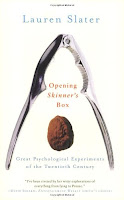
Book Reading #16 - Opening Skinner's Box

Author: Lauren Slater

CHAPTER 4: In the Unlikely Event of a Water Landing

Summary
In this chapter, the author Lauren Slater talks about a horrific crime that occurred in New York in 1964. A woman was stabbed and raped by a man at 3am. The unfortunate thing was that there were witnesses but they did not intervene. After this incident, Darley and Latane conducted some studies at New York University to try to find out the reason why people did not intervene even though they had the opportunity and enough time to do so.
In one of the experiment, they interviewed college student. They put him in a room and made him believe that there were more students in other students, however, the voices of the other students were pre-recorded. One of the prerecorded tapes had a student having a seizure, the experimenters wanted to see what the college student would do. The results were surprising, only 31% of the students reacted when they knew that other students were also listening, i.e. when they were in a group, however, 85% of the people reacted and tried to seek help when they felt they were alone, and the only person knowing about the other person's seizure.

Discussion
From the experiments, it could be seen that people failed to take action when they were in group or when there were bystanders. People tend to believe that it's not their sole responsibility to help the person in need if they are in crowd. I think this is also one of the reasons why people try to be more violent when they are in crowd since they think that the entire crowd would be blamed.

Book Reading #15 - Coming of Age in Samoa

CHAPTER 5: The Girl and her Age Group

Summary
This chapter describes a Samoan girl and the relationships she forms with people at different ages. When the girl is about six to seven years of age, girls make friends from outside of her family which includes kids from close by neighborhoods. However, no strong friendships are formed. Some girls tend to stay closer to the family members like aunts and grandmothers while some girls stay with their group of friends or chase the group of older females.
As the girl ages, other factors like family blood ties and family rank come into play. This restricts the interactions of the girls to some extent. When the girl reaches the age of sixteen-seventeen their group of friends is limited in size of 2-3 girls. Relationships and similar sex interests plays an important role in forming these small groups.
The author also talks about the relationships that the boys form as they age. When the boys are young, they form similar relations like the girls do, but when they grown older they form larger groups which teaches them important values like co-operation and teamwork. Also, there exists a special relationship between two boys who are best friends, its called Soa.

Discussion
So far, I have been noticing striking similarities in the highly developed eastern and western cultures and the Samoan culture. However, I noticed that there are significant differences in the day girls form relationships in the Samoan community and in the more developed parts of the world. However, it was interesting to read the detailed descriptions of their social interactions and relationships that the author provides.

Book Reading #14 - Design of Everyday Things


CHAPTER 5: To Err is Human

Summary
In this chapter the author Donald Norman talks about why and what kind of errors we humans usually commit. Two fundamental types of errors are - mistakes and slips. He further mentions different types of slips briefly and gives an example of each.
  • Capture errors: a frequently done activity takes charge of the one that the person intends to perform.
  • Description errors: the intended action has a lot in common with other possible actions.
  • Data driven errors: Data driven sensory that cause a different action.
  • Associative action errors: these deal with the internal thoughts that trigger actions and the association between the thoughts and actions.
  • Loss-of-action errors: forgetting the action that the person was supposed to perform
  • Mode errors: trying to perform the action while the device is in the wrong mode.
Slips and errors can be detected and prevented only if there is a proper feedback. It is important to provide forcing functions, proper feedback and clear instructions to avoid errors.

Discussion
I thought this chapter was very interesting since it was very different from most of the other chapters and covered a totally new topic - errors. It's interesting to read the detailed description of different types of errors and how much thought the author has put into analyzing the different types of error, their cause and possible solutions to prevent those errors.

Paper Reading #7: Hard to use interfaces considered beneficial (some of the time)

Reference Information:
Title: Hard to use interfaces considered beneficial (some of the time)
Authors: Riche Yann, Riche Nathalie, Isenberg Petra and Bezerianos Anastasia.
CHI 2010, April 10–15, 2010, Atlanta, Georgia, USA.

Summary:
Researchers in HCI share a common understanding that ‘easy-to-use’, ‘easy-to-learn’ and ‘intuitive’ interfaces are beneficial to users. Designing such interfaces raises challenges and often requires multiple iterations. While the designers are generally prompted to discard more hard-to-use interfaces and smooth out usability issues, this paper talks about their potential benefits. The researchers observed potential benefits from introducing barriers for collaborating and communicating with others. The authors attempt to shed a new light on interfaces with usability problems and how these problems may benefit system efficiency and user experience. Authors state that that barriers in interfaces can benefit game play, learning, to guide users to improve their efficiency with advanced features, and more broadly the experience with a system.

Discussion:
In the experiment, the researchers purposely induced some barriers in the user interface and recorded the observations. They found that having some barriers and limiting communication can enhance the learning experience. Also, the users get a sense of achievement after they have learnt something after consistently trying. However, I don't quite share the same ideas. I think if the user finds an alternative more easy-to-use solution in the market, he/she will most likely buy that product. Users get easily frustrated since most people don't have enough patience. Overall, the authors did provide an interesting idea, but it wasn't very convincing for me.