Showing posts with label Opening the skinners box. Show all posts
Showing posts with label Opening the skinners box. Show all posts
Wednesday, April 6, 2011

Friday, March 18, 2011
Book Reading #34 - Opening Skinner's Box

Chapter 10: Chipped
Author: Lauren Slater
Summary:
This last chapter of the book talks about the evolution of psycho surgery and about Antonio Moniz, who was the father of psycho surgery. In some of the early surgeries that he performed, he used alcohol to kill the damaged nerve tissue. Majority of his surgeries are reported to be successful but questions are raised regarding poor follow up concerning validity of the data.
Later in the chapter the author talks about a man called Charlie Newitz from Austin, Texas who suddenly showed symptoms of OCD. He tried all medications but nothing worked for him. He finally underwent psycho surgery. The surgery was successful and his OCD was gone. However, he reported feeling a little depressed after the surgery, however, it was much better than suffering from OCD.
Finally, the authors talks about psychiatric medicines like the prozac. No one really know which part of the brain it affects and how it works. Also, it does and does not help some people. Some people eventually get immune to it's effects and do not show improvements. Most times, it's just trial an error.
Discussion:
I think I oppose both medications and surgery. I believe, they both must be avoided if the condition is not bothering the person. However, if the condition worsens then the person has to take the drugs. Surgery should be left as a last resort since brain is such a delicate organ. Once small mistake can cost a life and such mistakes can't be undone. But overall, it looks like these days psych surgery has evolved considerably and doctors have good knowledge about the brain and even the tools are more sophisticated. So, today it's probably not as risky as it was before.
Book Reading #32: Opening the Skinner's Box

Chapter 9: Memory Inc.
Author: Lauren Slater
Summary:
The chapter focuses on Eric Kandel's research on human memory and how it's stored in the brain. The chapter begins with the story of Henry who had epilepsy and very often suffered from convulsions and seizures. Dr Scoville contacted his parents and proposed a possible solution of brain surgery. Being the last resort, Henry's parents consented the surgery. Dr. Scoville removed the hippocampus from Henry's brain which stopped the seizures but he lost the ability to form new memories.
After reading about Henry's story, Eric Kandel decided to learn about neurons and human memory. He experimented with sea slugs since their neurons are visible and less complex. He discovered CREB (cAMP response element binding) and CREB repressor. CREB is a molecule in the brain that triggers the genes which produce proteins that hold memories. Later, Kandel started a company that manufactured pills to enhance memory.
Discussion:
This was an extremely interesting chapter. I idea of making pills to enhance memory was interesting but the question that pops up in my head is that if scientists believe that the human memory is limited then won't this pill create some negative side effects as well? I think human brain being such a fragile organ should be left as it is.
Saturday, February 26, 2011
Book Reading #29 - Opening Skinner's Box (Mar 1)

Chapter 8: Lost in the Mall
Summary:
In this chapter, the author talks about Elizabeth Loftus's research about human memory. Loftus says that there exists a very thin curtain between memory and imagination. And often times, we tend to confuse things between memory and imagination. She says that long term memory is very fragile and can be easily tampered and manipulated to some extent. Loftus believed that in many of the cases involving child abuse, people were wrongly convicted based on the memories of the children who grew up and claimed that they had memories of their parents abusing them when they were young. Loftus claims that such deviations are possible and the people convicted were not necessarily guilty. To prove this, she had to prove that it's not only possible to distort memories, but it's totally possible create fake memories. "lost in the mall" experiment told participants about their true childhood stories and then added a fake one about them being lost in a mall when they were young. Their parents cooperated in the experiment. The participants were given an option to deny remembering this event if they really couldn't recollect the memories. However, surprisingly large number of participants actually believed that they were lost in the mall and came up with stories of how they were lost. When they were told about the experiment, they were shocked and surprised.
Loftus claims that we hate white empty spaces in our memories. If we can remember something, we tend to make something up to fill in the memory gap and this may or may not be true, something deviating entirely from the truth. When someone trustworthy tells us something about our past, something that really did not happen, we tend to believe it and start believing it firmly as if the event indeed did occur. However, some psychologists argue that traumatic memories are very different than regular memories and that they are stored differently. Traumatic memories can never be forgotten or tampered with.
Discussion:
This was a very interesting chapter that made me doubt my memory ten times while I was reading different incidents mentioned in the chapter. I started doubting if my memories are genuine or is most of it my imagination. Most importantly, I think Loftus is talking about so much more than memory. She's talking about authenticity and whether we, as human beings, have it. If we can successfully fool our memories, then we probably don't have it.
Thursday, February 24, 2011
Book Reading #26 - Opening Skinner's Box

Chapter 7: Rat Park
Summary:
This chapter is about a psychologist named Bruce Alexander and his research about addiction. He challenged the established theories supporting addiction to narcotic substances. Addiction psychologists like Dr. Herbert Kleber believe that the ease of access to narcotics significantly increase the risk of addiction. However, Alexander firmly believed that there is nothing inherently addictive about any drugs and repeated exposure to even the most enticing drugs do not usually lead to problems. He claims that prior to the temperance movement when opium was legal, the levels of addiction remained at a steady one percent of the population.
In some of the experiments, it was proved that rodents were so addicted to narcotics that they were willing to torture themselves and suffer pain to suck their drug through the straw, which most psychologists believed to be a compelling evidence of addiction. Alexander believed that the rodents became addicts because they were kept in worst conditions, crammed in tiny cages. He felt that if they were kept in a comfortable environment, they would probably not choose the drugs. He proved to be correct. In his experiment called the "Rat Park", he designed a park for lab rats which sufficient space and clean water. The rats that were kept in crammed environment kept striving for drugs while the lab rats in the rat park refrained from any drugs that the experimenters tried to administer. Some of the already addicted rats that were forced to ingest drugs preferred not to take drugs while they were in the happy surroundings.
Thus, Alexander's point was that we are prone to drug addiction if we are surrounded by sad environment, dejection and misery i.e. difficult circumstances lead to addiction. If we are happy in our lives and have almost everything that we desire, we would never get addicted to narcotics.
Discussion:
Alexander indeed had a valid point, however, I think that the mood of the surrounding environment and availability both play a role in addiction. I do agree that if we have nothing to whine for, if there's nothing or very little in our lives to complain about, then we won't be at a risk of a drug addiction. However, most of our lives aren't perfect. We have to often face failures. If drugs were freely available, we would probably use them in a state of mental imbalance like many people drink alcohol when they are upset. The fact that they are illegal and not easily available keeps its usage to low levels.
Monday, February 21, 2011
Book Reading #23 - Opening Skinner's Box

Chapter 6: Monkey Love
Summary
This chapter talks about Harry Halow's experiments with primates to find what's love. Harry Harlow himself experienced bouts of depression throughout his life and in school, he did not fit in. When Harlow moved to Madison, he began testing monkey intelligence, sort of simian IQ profile. Harlow separated the new born monkeys from their mothers. He observed that they became extremely attached to the terry cloth towels. He came up with the theory, that the sense of "touch" is the basis of forming love. The terry cloth towel was soft and that's what the monkeys used to touch and they became extremely attached to those towels. Harlow then made surrogate mothers, one made out of wire and sharp nails but this one had milk. Other surrogate mother was made out of terry cloth towels but it was dry. The monkeys were still attached to the terry cloth surrogate mother, even though they went to the other one only when they were hungry. Thus, Harlow concluded that "touch" and not "taste" was the basis of forming love.
To examine the power of touch, he put some new born monkeys with Iron Maidens, who pumped freezing water over their children, punched and stabbed the children. No matter what the torture, the babies came back to her. This showed that love is very strong and that we are creatures of faith. Since only touch was important, this notion changed the idea of neonatal care.
However, later he observed that cloth-mothered monkeys were violent and anti-social. So, there was something more than just touch that was important for their development. If the monkeys weren't allowed to socialize and play with other monkeys while they were growing up, they would turn hostile towards them later on. Len Rosenblum, one of the Harlow's students proved that it was "touch","motion" and "play" that lead to the development of a normal monkey.
Discussion
I think it was very cruel to separate new born monkeys from their mothers and then torturing them with different types of experimentation. However, the experiment did teach us something of tremendous value. Now we know what's needed for a proper development of a child. The contributions of Harlow and his students to the field of psychology is tremendous, however, the cruelty against those poor animals can definitely not be forgotten.
Book Reading #20 - Opening Skinner's Box
 Author: Lauren Slator
Chapter 5: Quieting the Mind
Summary:
In this chapter, author Lauren Slater talks about Leon Festinger's theory of Cognitive Dissonance. Cognitive Dissonance can be defined as the phenomenon in which people alter their thoughts and actions to match their surroundings and circumstances. The author mentions some of the Festinger's experiments in which people believed that a massive flood would come on December 21, 1954. In another experiment, he had people lie for $1 and for $20.
Major part of this chapter talks about a woman named Linda Santo who claims that her daughter is a saint. She claimed that her daughter was a victim soul and was born to take the pains for others' sins. Interviews with Linda Santo give more information and raise some questions about cognitive dissonance.
Discussion:
I thought that some of questions raised and facts stated in this chapter were unclear and ambiguous as compared to the other chapters. However, the topic of cognitive dissonance presented by the author was extremely fascinating. I believe that the area has not received much attention and more experiments need to be conducted to better understand the concept of Cognitive Dissonance.
Thursday, February 10, 2011
Book Reading #16 - Opening Skinner's Box
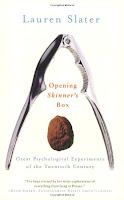 Author: Lauren Slater
CHAPTER 4: In the Unlikely Event of a Water Landing
Summary
In this chapter, the author Lauren Slater talks about a horrific crime that occurred in New York in 1964. A woman was stabbed and raped by a man at 3am. The unfortunate thing was that there were witnesses but they did not intervene. After this incident, Darley and Latane conducted some studies at New York University to try to find out the reason why people did not intervene even though they had the opportunity and enough time to do so.
In one of the experiment, they interviewed college student. They put him in a room and made him believe that there were more students in other students, however, the voices of the other students were pre-recorded. One of the prerecorded tapes had a student having a seizure, the experimenters wanted to see what the college student would do. The results were surprising, only 31% of the students reacted when they knew that other students were also listening, i.e. when they were in a group, however, 85% of the people reacted and tried to seek help when they felt they were alone, and the only person knowing about the other person's seizure.
Discussion
From the experiments, it could be seen that people failed to take action when they were in group or when there were bystanders. People tend to believe that it's not their sole responsibility to help the person in need if they are in crowd. I think this is also one of the reasons why people try to be more violent when they are in crowd since they think that the entire crowd would be blamed.
Book Reading #13 - Opening Skinner's Box

CHAPTER 3: On being sane in insane places
Summary
David Rosenhan wanted to test how well could the psychiatrists differentiate between the sane and the insane. With a motive to find an answer to this question, David along with his eight friends showed up at different reputed mental hospitals and said that we were hearing a noise that said "thud". After being in the ward, they acted perfectly normal and claimed that they weren't hearing the noise any more. They wanted to test if the doctors were able to distinguish them from the insane. Unfortunately, they were administered the treatment even though they were perfectly fine. This study lead to great progress in the field of psychology. The author talks about Diagnostic and Statistical Manual on Mental Disorders evolved as a result of Rosenhan’s study. Finally, she also talks about the same study repeated by herself and her findings.
Discussion
It was very interesting to read about the study and I was appalled to learn that all the psychiatrists mistakenly admitted Rosenhan and his friends. Also, when the author repeated the experiment, although she wasn't admitted, she was given anti depressants. Learning that doctors just don't want to hear no for an answer was a bit shocking.
Wednesday, February 2, 2011
Book Reading #10 - Opening Skinner's Box

Chapter 2: Obscura
Summary:
In this chapter, the author Lauren Slater describes Stanley Milgram and his experiment about obedience to authority.
The Experiment:
In 1961, Stanley Milgram, an assistant professor of psychology at Yale University wanted to study how people succumb to authority and become willing to perform atrocities. He performed his experiment in the night, in a small shady room. There were three people involved in each experiment - the volunteer, who was given the role of the teacher and two actors paid by Milgram, one of whom played the role of the learner and the other wore a white coat and instructed the teacher (volunteer) with orders. The learner was instructed to sit in an electric chair and the teacher was asked to question the learner. If the learner made a mistake, the teacher was advised to administer him an electric shock. The intensity of the electric shock went up with the number of mistakes. It started with 15V electric shock for the first mistake and went up to 450V. As the intensity went up, the teacher could see the learner in agony when the sock was administered as a punishment. If the teacher wanted to stop, he wasn't allowed to and was insisted to continue by the guy in the white coat. However, the teacher did not know that the electric generator and the electric chair are fake and the two guys are paid actors who worked for Milgram.
The Findings:
Sixty five percent of us, when faced with credible authority, will follow the orders to the point of lethally harming the person. Catholics were more obedient than Jews, but there were no concrete personality traits that separated the obedient from defiant.
Importance of the study:
The power if Milgram's experiment lies in the great gap between what we think about ourselves and who we really are. How any normal person can become a killer if he finds himself in a place where killing is called for. The studies raised a research question that which qualities and personality traits make a man autonomous. Many participants in the study claimed that the experiment proved to them how powerless and vulnerable they were and that the experiment changed their lives. It motivated them to take control of the situation.
Discussion:
I was totally intrigued by Stanley Milgram's personality, his experiment and his findings. Some people consider his actions to be controversial, or even brutal but I share a somewhat different opinion. Many great inventors and scientists including Newton were surrounded by controversies, but, I think we should focus on their contributions rather than highlighting the controversies. According to the utilitarian theory of ethics, Milgram did not do anything that was ethically wrong. He did not physically harm or injure any one nor did he force anyone to participate in his experiment.
This article got me thinking - "if I was the one playing the teacher in that room in the basement, what would I do? Would I be obedient or defiant?". However, answer to this question can not be hypothesized unless we are ourselves in that situation surrounded by the same shady environment that surrounded the participants. There is no way I can answer this question sitting on my couch with my legs crossed, while enjoying this wonderful book and sipping a cup of tea.
Monday, January 31, 2011
Book Reading 7 - Opening Skinner's Box

Chapter 1: Opening Skinner’s Box
Reference Information:
Title: Opening Skinner's Box: Great Psychological Experiments of the Twentieth Century
Author: Lauren Slater
Publisher: W. W. Norton & Company; 1 edition (March 15, 2004)
Summary:
The chapter talks about the great scientific experiments of the late psychologist B.F. Skinner and the accomplishments, criticisms and controversialists that surrounded his methods. Skinner spent much of his scientific career studying and honing what he came to call operant conditioning, the means by which humans can train humans and other animals to perform a whole range of tasks and skills through positive reinforcement.
Although his contributions are enormous and that the time magazine named him the most influential living psychologist, he was surrounded with some contradictions and controversies. Skinner believed that "we are always either controlled or controlling, that our free will is really just a response to some cues that" He believed that rewards work far better in the establishment of behavior rather than punishments. Skinner's techniques have been instrumental in helping the huge population of anxiety-disordered people overcome their phobias. His theories also greatly helped patients of schizophrenia.
Discussion:
I found this chapter extremely interesting. The controversy of the skinner's box and of his daughter committing suicide kind of gave a suspense genre to the overall tone of the chapter. His experiments and methods of study was so unconventional that I could not stop myself from google-ing more information about him and digging deeper into understanding his works and personality.
Regardless of the controversies, this man has earned my respect for his contribution to the field of psychology with his concepts of positive reinforcement and behaviorism. The ideology of positive reinforcement is not vital to just psychology, but also finds its application in management studies. Today, company management and leaders use his theory of positive reinforcement to shape employee behaviors by rewarding the hard work.

Subscribe to:
Posts (Atom)